

Fraktal
A control and automation framework for machine builders — from the PLC to the operator HMI.
Compose the machine from tested module types. Write only the step sequences. Do not build an HMI at all: the machine describes itself, and one generic HMI discovers it.
Alpha pre-release. The framework, the reference implementation and the toolchain are complete enough to build and run a station end-to-end, and are gated on every commit. They have not yet run a production line. §Status below says exactly what is proven and what is not — this project reports that honestly rather than aspirationally (O10).
Concept
Section titled “Concept”The goal is to bring a machine into service with as little application programming as possible, and to make what remains the part that is actually specific to your machine.
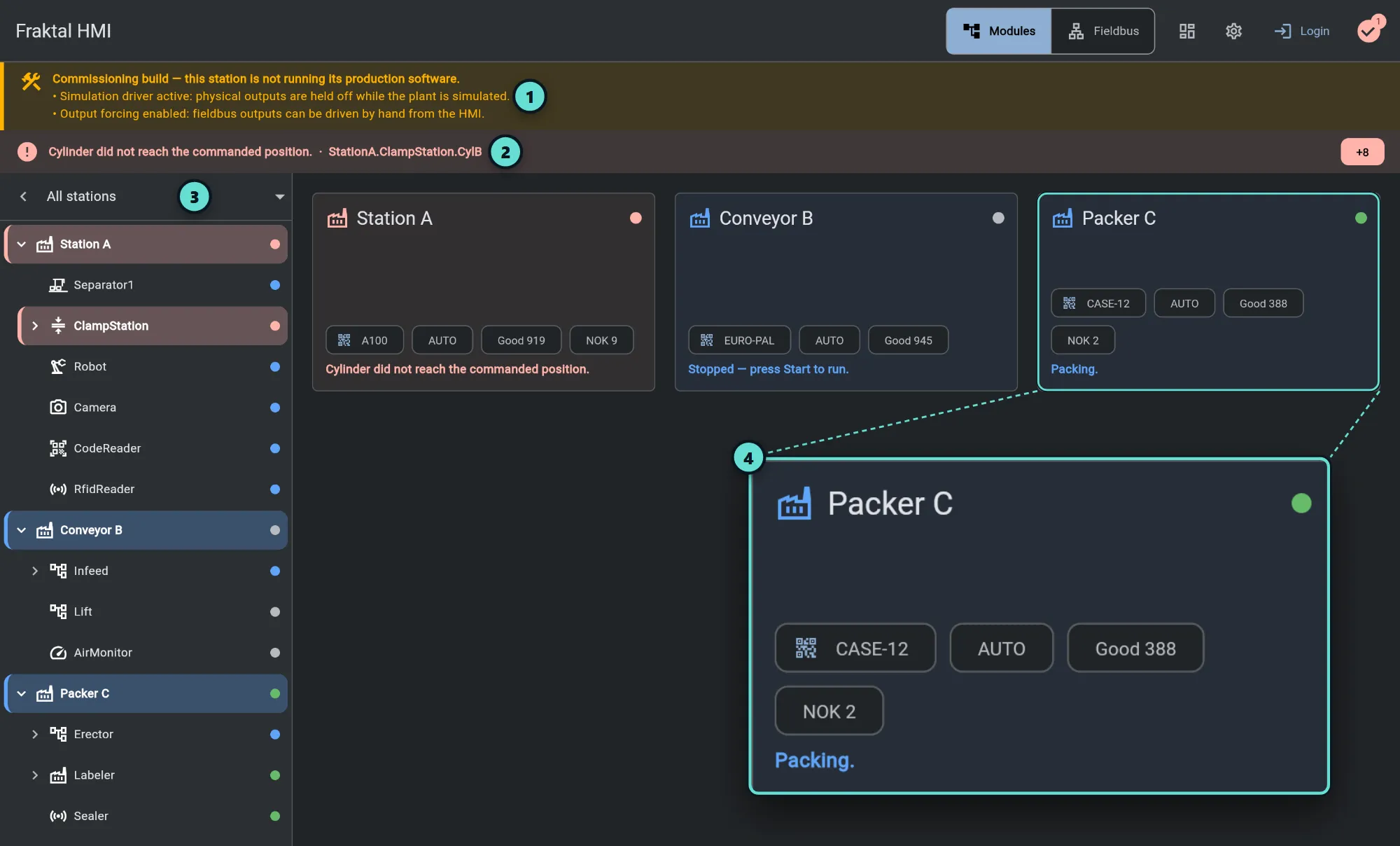
- A commissioning build says so: here the simulation driver and output forcing are active.
- The active event and the module that raised it.
- The module tree: each root Unit and its modules.
- One tile per root Unit, here Packer C: model, mode, counters and its current message.
a1163c7 · try itCompose, don’t write. Equipment is assembled from reusable module types in
three recursive tiers — device (FB_ControlModule), bounded function
(FB_EquipmentModule), station (FB_Unit). A type is declared, wired once in
Setup, and it is finished: it ships with its own tests, its own reason codes,
and its own published contract.
Inherit everything that is the same on every machine. The PLCopen command handshake, mode and state machines, first-out diagnostics, the alarm model, recipe load and migration, part traceability, the OPC UA data contract, and the HMI data mirror are written once at the level that owns them and inherited. A concrete type overrides one method — its device logic — and nothing else.
The HMI is not built, and not generated either. The station publishes its own module forest over OPC UA; a single generic HMI walks it at runtime and renders the tree, the commands, the alarms and the §3.13 flow charts. Add a module and it appears. There is no per-station screen code, and — unlike a generator — no generated artifact to regenerate, redeploy, or keep in sync when the machine changes.
What is left for you to write is the step sequence. The process itself: what this machine does, in what order. In ST, SFC or Ladder — the choice is the author’s, and all three are the same chain against the same base class.
What you write vs. what you inherit
Section titled “What you write vs. what you inherit”| Written per machine | Inherited / discovered | |
|---|---|---|
| Device logic | one CASE in _M_Dispatch per new type |
lifecycle, edges, state mapping, abort, reset |
| Sequences | the steps and their order | step records, stall diagnosis, timing, re-arm |
| Interlocks | the conditions, by name | first-out selection, release reports, HMI display |
| Commands | which child, which command | the entire §6.1 handshake |
| Alarms | a reason code from your band | ring buffer, rationalisation, shelving, audit |
| Recipes | the record layout | provider transport, migrate-or-fault, changeover |
| HMI | nothing | the whole operator interface |
| I/O | tags, addresses, polarity | bounds, health, duplicate and diagnostic joins |
What Fraktal is not
Section titled “What Fraktal is not”Stated plainly, because the concept above invites the comparison:
- There is no graphical machine configurator. You compose in IEC 61131-3 declarations, not in a wizard.
- PLC code is not generated from a machine description. The toolchain generates bodies — ladder rungs and chart steps from a declaration, module scaffolds — and mechanically checks the rest. It does not synthesise a station.
- It is not a runtime you buy. It is a standard, a reference implementation, and the gates that keep the two honest, under AGPL-3.0-only.
The full objective set (O1–O10, in priority order) is in
Specification/Fraktal_Core_Part_I.md §1.1 —
including O9 good coding and engineering practice and O10 industrial-grade
robustness.
Why it is built this way
Section titled “Why it is built this way”Equipment software is usually rewritten per machine, per station, per screen. Fraktal pays standardisation once per reusable module type, not once per step or per station:
- Write less. Issue a command, wait for
Done. No per-step boilerplate; the lifecycle, state mapping, and HMI data mirror are inherited from base classes. - Diagnose for free. When a sequence stalls, the operator gets a precise root
cause — “Step N stalled → awaiting
Module.Command→ reason” — produced automatically from the contract, never hand-coded. - Render generically. The HMI walks the self-describing module forest over OPC UA. Adding a module type adds HMI automatically; a station adds zero HMI code.
- Scale. One model composes device → equipment module → unit → whole line; and the published/streamed surface stays proportional to what is consumed (config served on demand, live data tiered by cadence).
Fraktal synthesises established industry practice — ISA-88/IEC 61512 (physical & procedural model), PLCopen (command handshake, motion & safety FBs), ISA-18.2 alarm management, IEC 62443 security, and the OPC UA companion models — into one coherent architecture, defined platform-neutrally and delivered first as a TwinCAT 3 binding with a Flutter operator HMI.
Repository layout
Section titled “Repository layout”Specification/ The standard — and ONLY the standard, at this level. Fraktal_Core_Part_I.md Part I — platform-neutral normative core (§1–14) Fraktal_TC3_Part_II.md Part II — the TwinCAT 3 binding (Fraktal/TC3) Fraktal_AB_Part_III.md Part III — the Allen-Bradley Logix binding (draft, pre-spike) HMI_CONTRACT.md the symbol → widget bind table the HMI implements OPCUA_TRANSPORT.md the OPC UA transport, config manifest & read tiers SAFETY_AND_CONTROL_POWER_PROFILE.md the §9.8 profile LOCALIZATION_AND_MODULE_CONTENT.md the localization/content contract reason_rationalization.json the §8.9 registry (machine-read) Annexes/ worked examples A–K exercising every contract end-to-end Guides/ how to apply it: first project, XAE workflow, deployment Reports/ audits, status, plans, one-off analyses Evidence/ dated TwinCAT runtime evidence (append-only) AllenBradley/ the Fraktal/AB working set + its spike evidence README.md what belongs at each level, and why
FraktalCore/ PLC/ One directory per platform binding (§1.1 O8: the model is portable, each platform is served by its own binding) TwinCAT/ Fraktal/TC3 reference implementation (IEC 61131-3) Framework/ the reusable libraries — what a station consumes Fraktal_Core/ base classes, contracts, providers Fraktal_Modules/ reusable module library (cylinder CM, clamp EM, …) Examples/ executable internal fixtures, NOT conformance targets CoreDemo/ two-root generic demo application (sources only) PressDemo/ internal feature-testing bench + PressTests suite Tests/ isolated validation sources Fraktal_Tests.plcproj the aggregate TcUnit manifest Fraktal_Tests/ Core + Modules suites (simulated HAL) scaffold/ copy-template for a new module type (ships SKELETON.md) tools/ the TwinCAT gates and generators (they ship inside the binding they check — see below) Allen-Bradley/ binding drafted (Part III) + its own tools/ probe suite HMI/ Generic operator HMI (Flutter, Material 3) — Windows/Linux/Android/Web lib/ the app (data / domain / state / ui) native/opcua/ native OPC UA client (open62541 + Mbed TLS via dart:ffi) gateway/ headless WebSocket gateway for the Web transport
FraktalCore/PLC/TwinCAT/tools/ The TwinCAT gates and generators. They live inside the binding they check, beside Allen-Bradley/tools/, so a binding carries its own toolchain and neither can silently drift. plc_lint.py 18 source rules, both build profiles ld_rung_gen.py ladder rungs from a declaration; ld_dump / sfc_dump read them back Invoke-TwinCatBuild.ps1 CheckAllObjects on every solution Invoke-TwinCatTcUnitGate.ps1 / tcunit_to_junit.py runtime gate + result validation
tools/ The repository-level gates — the ones that span more than one tree check_consistency.py agreement BETWEEN artifacts (PLC ↔ HMI ↔ docs) check_ab_spec.py / check_ab_contracts.py the Fraktal/AB specification gates
AGENTS.md working briefing for AI coding agents editing this repoDocumentation map — start here
Section titled “Documentation map — start here”| You want to… | Read |
|---|---|
| Understand the model | Fraktal_Core_Part_I.md (§1 foreword, §3 architecture) |
| Build your first module | Fraktal_QuickStart_and_Suite.md |
| Deploy a station & connect the HMI | FIRST_PROJECT_AGENT_GUIDE.md |
| Reproduce XAE compile, library install, and TcUnit runs | TWINCAT_XAE_WORKFLOW.md |
| Bring up the PLC (TwinCAT) | FraktalCore/PLC/TwinCAT/README.md |
| Run / build the HMI | FraktalCore/HMI/README.md |
| See what’s proven vs. pending | OBJECTIVES_AUDIT.md |
| Know what is generated, checked, or still hand-written | AI_DEVELOPMENT_AND_AUTOMATION.md |
| Enable output forcing for commissioning | Fraktal_Core_Part_I.md §7.5 + Fraktal_TC3_Part_II.md TC3 §7.5 |
| Port Fraktal to another PLC platform | ALLEN_BRADLEY_PORT_PLAN.md |
| Read the Allen-Bradley binding (draft, pre-spike) | Fraktal_AB_Part_III.md |
Status (2026-08-16)
Section titled “Status (2026-08-16)”Proven at this revision
- PLC compile —
FraktalCore/PLC/TwinCAT/tools/Invoke-TwinCatBuild.ps1runsCheckAllObjects()on all five solutions (Core, Modules, the Press bench, and both test projects) under TwinCAT 4026, green — re-run at this revision against Core0.5.0.0/ Modules0.4.0.0after save-as-library and install, which is the step the applications need before they can resolve anything added to a library. - PLC runtime tests, Core + Modules — 106/106 across 31 suites, 0 failures
on the development usermode runtime (2026-08-16). Every suite that had never
executed now runs, including
ConfigWriteTestsandFB_Engineering_Tests. Evidence inSpecification/Evidence/. Run by an operator following the §6.2 procedure, not by the gate —Invoke-TwinCatTcUnitGate.ps1automates target selection and activation, but its PLC login does nothing (see Open below), so an earlier claim that it drove the run end-to-end has been withdrawn. - PLC runtime tests, Press bench — 8/8 tests across 2 suites, 0 failures
on an isolated VM, validated by
FraktalCore/PLC/TwinCAT/tools/tcunit_to_junit.pyagainst the expected runner identity and counts. Log, JUnit and SHA-256s inSpecification/Evidence/. - Press AUTO chain in all three sequence languages — the Ladder and SFC renditions have now executed on the test-bench PLC with the press demo (2026-08-16), alongside the ST twin that ships by default. This is what turns O2’s three-language promise from graph equivalence into execution. No log is archived for this run yet, so by the §8 evidence rule it is a recorded observation rather than release evidence.
- PLC source gate —
plc_lint.py: 294 files clean in both build profiles (modern and the 4024 legacy profile). - Cross-artifact gate —
check_consistency.py --strict: 0 errors, 0 warnings across test inventory, localization and ST↔LD sequence-rendition parity. Runs hosted on every commit. - Toolchain — 120 tests over the tooling itself (72 in the TwinCAT
binding’s own
tools/, 48 in the repository-leveltools/). - HMI —
flutter analyzeclean and 235 tests passing (4 intentional live-environment skips) on the pinned Flutter 3.44.6, re-run at this revision.
Not proven at this revision
- HMI builds —
flutter build web/windowssucceeded as of 2026-08-02 and have not been re-run since; only analyze and the test suite were. - §7.5 commissioning gates and §10.5.1 output forcing — the PLC half now
executes:
FB_Engineering_Testsis green in the Core + Modules run above, so the gate register, the standing annunciation and the fail-closed force gate are proven in execution rather than argued from source. Forcing has still never driven a physical terminal. Not implemented on Allen-Bradley (Part III), deliberately. - End-to-end over TF6100 — the Press bench has cycled on a development
runtime, published over OPC UA and driven the generic HMI (config-manifest
QUERY_CONFIG,OPC.UA.DAobscuring, live commanding). A development runtime is not a machine, and this is not a production acceptance result.
Open
- The PLC compile job is armed; the TcUnit job is not. A licensed
self-hosted runner is registered with the
twincatlabel andHAS_TWINCAT_RUNNERis set, soci.ymlcompiles the PLC from now on.HAS_TWINCAT_TEST_RUNTIMEstays unset deliberately — see the next item — and neither check can be made required while the host carries trial licences only, since renewal is an interactive captcha (§1.5 makes CI a shall). - The gate cannot log in to the PLC.
ITcPlcOnline.Login()returns without error, writes nothing to any DTE output pane, and leavesIsLoggedInfalse indefinitely. Everything up to activation is verified. The eliminations, and why guide §9’s “no hidden script logged in” now reads as a constraint rather than a preference, are recorded inTWINCAT_XAE_WORKFLOW.md§9.1. Reading a result is solved —Read-TcUnitResults.ps1pulls TcUnit’s own per-test results over ADS — but nothing can start the run for it to read. - Gateway read-tier parity for Web, live-transport and deployment-profile
acceptance, and the remaining items in
OBJECTIVES_AUDIT.md.
This project reports status honestly (O10): it distinguishes what is proven from what is deferred, and names the gaps rather than hiding them. A framework that overstates its own maturity is not one you can trust with a machine.
Quick start
Section titled “Quick start”PLC (TwinCAT 3, 4024+/4026): add each .plcproj to a TwinCAT XAE solution via
PLC → Add Existing Item… (do not open a .plcproj directly). Build & install
Framework/Fraktal_Core, then Framework/Fraktal_Modules, then the applications
under Examples/; run the aggregate TcUnit suite from its own FraktalTests.slnx. See
FraktalCore/PLC/TwinCAT/README.md.
HMI (Flutter): from FraktalCore/HMI/
flutter pub getflutter analyzeflutter testflutter run -d windows # or chrome (Web) / linux / androidNative OPC UA on Windows needs Developer Mode (Flutter plugin symlinks) and a
reachable opc.tcp:// server. See FraktalCore/HMI/README.md.
Contributing
Section titled “Contributing”- Read
AGENTS.md— the working briefing on the model, the coding guardrails, and where things live. It applies to humans too. - Every
shallin the spec is a requirement. Machine-verifiable rules (naming, contract usage, step/condition records, per-type tests) are meant to be enforced by a CI/lint gate on every commit (§1.5, §5.5) — see the audit for the plan to add it. - Reusable module types ship a TcUnit suite that runs against the simulated HAL and must be green before the type is released or changed (§5.7).
- Follow the idioms of the code around you (O9); keep changes to released types additive and versioned (§1.5).
License
Section titled “License”Fraktal’s current project distribution is licensed under the
GNU Affero General Public License, version 3 only
(AGPL-3.0-only). See LICENSING.md for the transition,
source-distribution obligations and third-party exclusions.
The current source of record is the MrFrakt/Fraktal monorepo.
Built from README.md at revision a1163c7 of the Fraktal repository.